
BULLETIN
Hurricane Harvey Advisory Number 22
NWS National Hurricane Center Miami FL AL092017
400 PM CDT Fri Aug 25 2017
…MAJOR HURRICANE HARVEY BEARING DOWN ON THE TEXAS COAST…
…CATASTROPHIC FLOODING EXPECTED DUE TO HEAVY RAINFALL AND STORM
SURGE…
SUMMARY OF 400 PM CDT…2100 UTC…INFORMATION
———————————————-
LOCATION…27.5N 96.5W
ABOUT 60 MI…95 KM ESE OF CORPUS CHRISTI TEXAS
ABOUT 60 MI…100 KM S OF PORT OCONNOR TEXAS
MAXIMUM SUSTAINED WINDS…125 MPH…205 KM/H
PRESENT MOVEMENT…NW OR 325 DEGREES AT 10 MPH…17 KM/H
MINIMUM CENTRAL PRESSURE…941 MB…27.79 INCHES
WATCHES AND WARNINGS
——————–
CHANGES WITH THIS ADVISORY:
The Tropical Storm Warning has been discontinued south of Port
Mansfield, Texas.
The Storm Surge Watch has been discontinued south of Port
Mansfield, Texas.
The government of Mexico has discontinued the Tropical Storm Watch
north of Boca de Catan.
SUMMARY OF WATCHES AND WARNINGS IN EFFECT:
A Storm Surge Warning is in effect for…
* Port Mansfield to High Island Texas
A Hurricane Warning is in effect for…
* Port Mansfield to Sargent Texas
A Tropical Storm Warning is in effect for…
* North of Sargent to High Island Texas
A Storm Surge Warning means there is a danger of life-threatening
inundation from rising water moving inland from the coastline in the
indicated locations. For a depiction of areas at risk, please see
the National Weather Service Storm Surge Watch/Warning Graphic,
available at hurricanes.gov. This is a life-threatening situation.
A Hurricane Warning means that hurricane conditions are expected
somewhere within the warning area, in this case within the next few
hours. Preparations to protect life and property should already be
complete.
Interests in southwestern Louisiana should continue to monitor the
progress of this system.
For storm information specific to your area, including possible
inland watches and warnings, please monitor products issued by your
local National Weather Service forecast office.
DISCUSSION AND 48-HOUR OUTLOOK
——————————
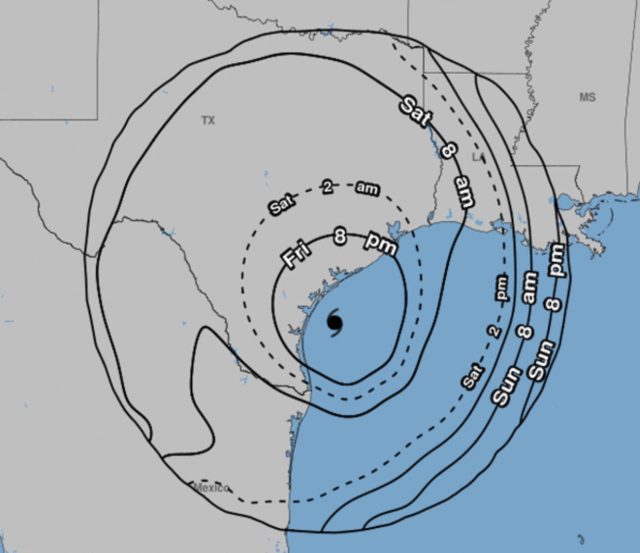
At 400 PM CDT (2100 UTC), the eye of Hurricane Harvey was located
by aircraft reconnaissance aircraft and NOAA Doppler radar near
latitude 27.5 North, longitude 96.5 West. Harvey is moving toward
the northwest near 10 mph (17 km/h), but its forward speed is
expected to decrease significantly during the next couple of days.
On the forecast track, Harvey will make landfall on the middle Texas
coast tonight or early Saturday. Harvey is then likely to meander
near or just inland of the middle Texas coast through the weekend.
Data from an Air Force Reserve Hurricane Hunter aircraft indicate
that maximum sustained winds have increased to near 125 mph
(205 km/h) with higher gusts. Harvey is a category 3 hurricane on
the Saffir-Simpson Hurricane Wind Scale. Some additional
strengthening is possible before Harvey makes landfall overnight.
Weakening is then expected over the weekend while the center moves
inland over Texas.
Hurricane-force winds extend outward up to 35 miles (55 km) from the
center, and tropical-storm-force winds extend outward up to 140
miles (220 km). A station at Aransas Pass, Texas, recently
reported a sustained wind 56 mph and a gust to 71 mph.
The minimum central pressure based on aircraft reconnaissance data
is 941 mb (27.79 inches).
HAZARDS AFFECTING LAND
———————-
RAINFALL: Harvey is expected to produce total rain accumulations of
15 to 30 inches and isolated maximum amounts of 40 inches over the
middle and upper Texas coast through next Wednesday. During the same
time period Harvey is expected to produce total rain accumulations
of 5 to 15 inches in far south Texas and the Texas Hill Country over
through southwest and central Louisiana. Rainfall of this magnitude
will cause catastrophic and life-threatening flooding.
STORM SURGE: The combination of a dangerous storm surge and the
tide will cause normally dry areas near the coast to be flooded by
rising waters moving inland from the shoreline. The water is
expected to reach the following heights above ground if the peak
surge occurs at the time of high tide…
N Entrance Padre Island Natl Seashore to Sargent…6 to 12 ft
Sargent to Jamaica Beach…5 to 8 ft
Port Mansfield to N Entrance Padre Island Natl Seashore…3 to 5 ft
Jamaica Beach to High Island…2 to 4 ft
Mouth of the Rio Grande to Port Mansfield…1 to 3 ft
High Island to Morgan City…1 to 3 ft
The deepest water will occur along the immediate coast near and to
the northeast of the landfall location, where the surge will be
accompanied by large and destructive waves. Surge-related flooding
depends on the relative timing of the surge and the tidal cycle, and
can vary greatly over short distances. For information specific to
your area, please see products issued by your local National Weather
Service forecast office.
WIND: Tropical storm conditions are occurring in portions of
the hurricane and tropical storm warning areas, and hurricane
conditions are expected to begin within the hurricane warning area
in the next few hours. Tropical storm conditions are likely to
persist along portions of the coast through at least Sunday.
SURF: Swells generated by Harvey are affecting the Texas,
Louisiana, and northeast Mexico coasts. These swells are likely to
cause life-threatening surf and rip current conditions. Please
consult products from your local weather office.
TORNADOES: A few tornadoes are possible through Saturday near the
middle and upper Texas coast into far southwestern Louisiana.
NEXT ADVISORY
————-
Next complete advisory at 1000 PM CDT.