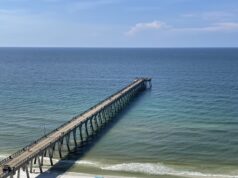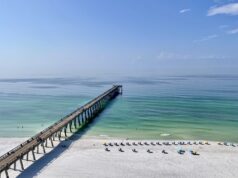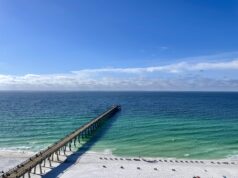

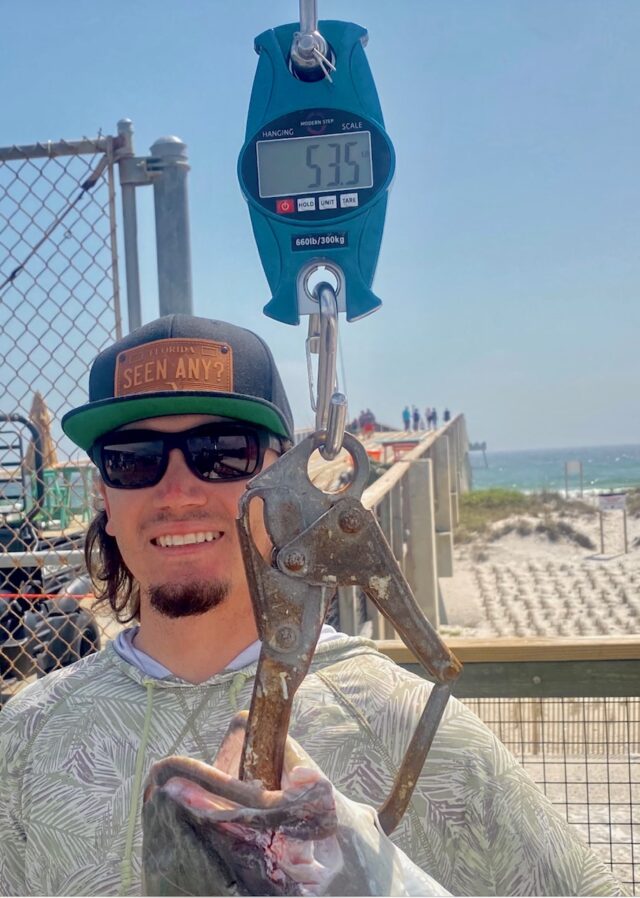
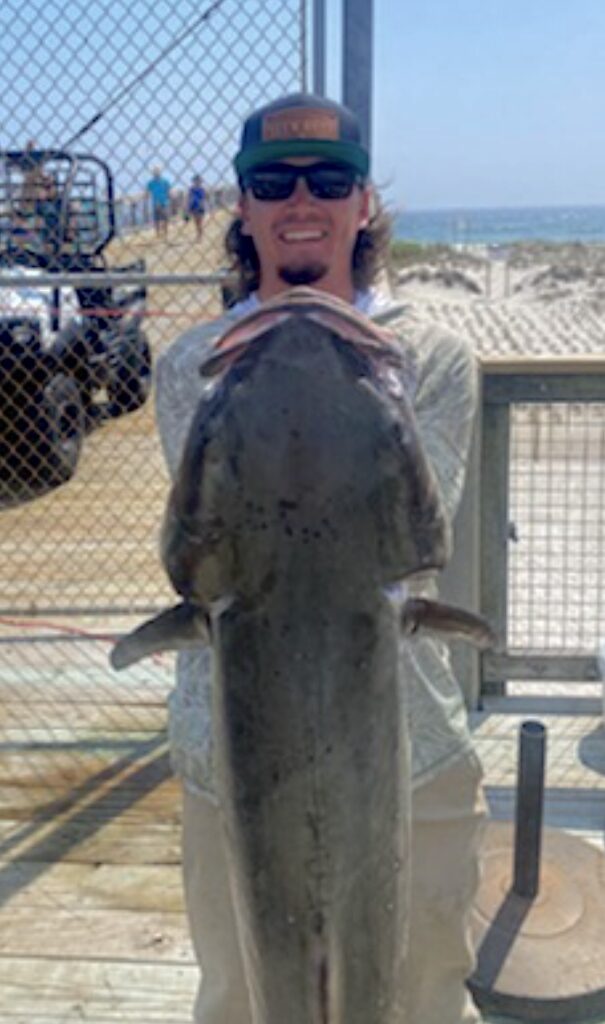
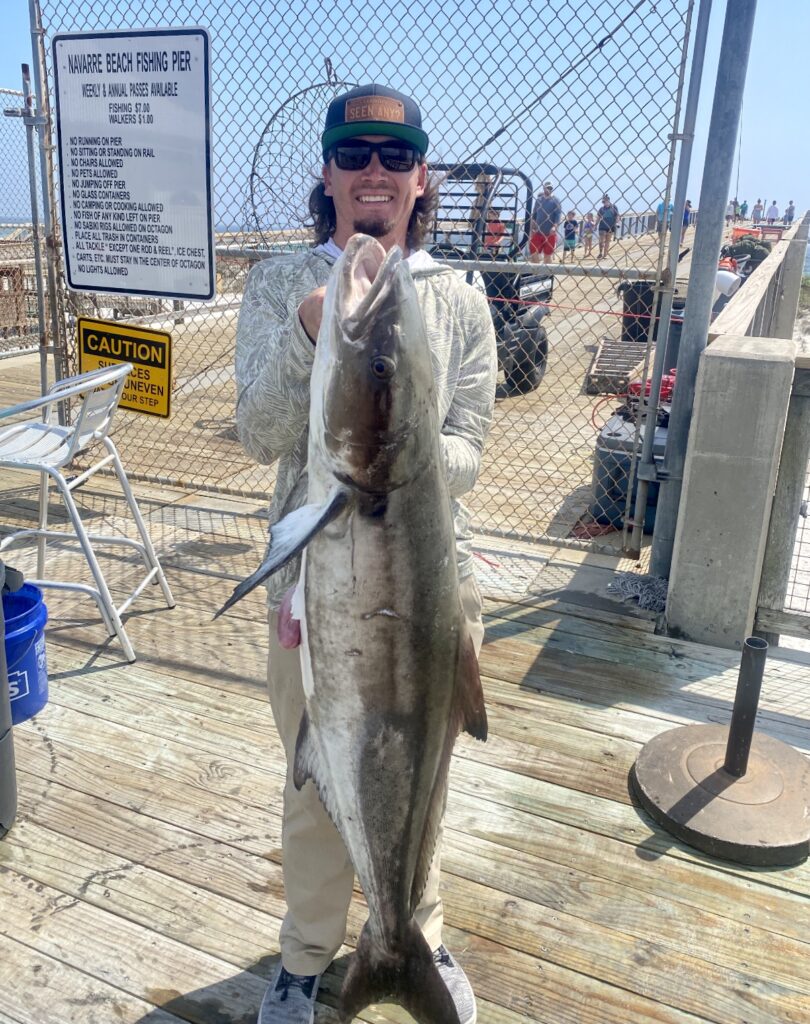
This afternoon Jordan Laws caught the first Cobia 53.5 lbs , of the season from the Navarre fishing pier. Jordan will receive a years pier pass courtesy of the County.Below is information about this very popular fish and more photos.
Information below is from Wikipedia;
The cobia (Rachycentron canadum) is a species of carangiform marine fish, the only representative of the genus Rachycentron and the family Rachycentridae. Other common names include black kingfish, black salmon, ling, lemonfish, crabeater, prodigal son and black bonito.
Attaining a maximum length of 2 m (78 in) and maximum weight of 78 kg , the cobia has an elongated, fusiform (spindle-shaped) body and a broad, flattened head. The eyes are small and the lower jaw projects slightly past the upper. Fibrous villiform teeth line the jaws, the tongue, and the roof of the mouth. The body of the fish is smooth with small scales. It is dark brown in color, grading to white on the belly with two darker brown horizontal bands on the flanks. The stripes are more prominent during spawning, when they darken and the background color lightens.
The large pectoral fins are normally carried horizontally, perhaps helping the fish attain the profile of a shark. The first dorsal fin has six to nine independent, short, stout, sharp spines. The family name Rachycentridae, from the Greek words rhachis (“spine”) and kentron (“sting”), was inspired by these dorsal spines. The mature cobia has a forked, slightly lunated tail, which is usually dark brown. The fish lacks a swim bladder. The juvenile cobia is patterned with conspicuous bands of black and white and has a rounded tail. The largest cobia taken on rod and reel came from Shark Bay, Australia, and weighed 60 kg.
The Cobia resembles its close relatives, the Remoras of the family Echeneidae. It lacks the Remora’s dorsal sucker and has a stouter body.
The cobia is normally solitary except for annual spawning aggregations, and it sometimes congregates at reefs, wrecks, harbours, buoys, and other structural oases. It is pelagic, but it may enter estuaries and mangroves in search of prey.
It is found in warm-temperate to tropical waters of the West and East Atlantic Ocean, throughout the Caribbean, and in the Indian Ocean off the coast of India, Australia, and off the Pacific coast of Japan.[5] It is eurythermal, tolerating a wide range of temperatures, from 1.6 to 32.2°C. It is also euryhaline, living at salinities of 5.0 to 44.5 ppt.
The cobia feeds primarily on crabs, squid, and fish. It follows larger animals such as sharks, turtles, and manta rays to scavenge. It is a very curious fish, showing little fear of boats.
The predators of the cobia are not well documented, but the mahi-mahi (Coryphaena hippurus) is known to feed on juveniles and the shortfin mako shark (Isurus oxyrinchus) eats the adult.
The cobia is frequently parasitized by nematodes, trematodes, cestodes, copepods, and acanthocephalans
The cobia is a pelagic spawner, releasing many tiny (1.2 mm), buoyant eggs into the water, where they become part of the plankton. The eggs float freely with the currents until hatching. The larvae are also planktonic, being more or less helpless during their first week until the eyes and mouths develop. The male matures at two years and the female at three years. Both sexes lead moderately long lives of 15 years or more. Breeding activity takes place diurnally from April to September in large offshore congregations, where the female is capable of spawning up to 30 times during the season.
The cobia makes seasonal migrations. It winters in the Gulf of Mexico, then moves north as far as Massachusetts for the summer, passing Florida around March.
The cobia is sold commercially and commands a relatively high price for its firm texture and excellent flavor. However, no designated wild fishery exists because it is a solitary species. It has been farmed in aquaculture. The flesh is usually sold fresh. It is typically served in the form of grilled or poached fillets. Chefs Jamie Oliver and Mario Batali each cooked several dishes made with cobia in the “Battle Cobia” episode of the Food Network program Iron Chef America, which first aired in January, 2008. Thomas Keller’s restaurant, The French Laundry, has offered cobia on its tasting menu.